


Who we are
Equality, Diversity and Inclusion
Equality, Diversity and Inclusion
Accessible Information Standard
If you have any questions about this, either speak to one of our staff or email ghc.comms@ghc.nhs.uk
Equality Act 2010
- eliminate unlawful discrimination, harassment and victimisation and other conduct prohibited by The Equality Act 2010
- advance equality of opportunity between people from different groups
- foster good relations between people from different groups. This involves tackling prejudice and promoting understanding between people from different groups
The Equality Act 2010 outlaws acts of discrimination against the following nine protected characteristics:
- Age
- Disability
- Sex
- Gender reassignment
- Marriage and civil partnership
- Pregnancy and maternity
- Race
- Religion or belief
- Sexual orientation
Equality Delivery System
EDS Reporting Template and Action Plan 2024
EDS Reporting Template and Action Plan 2023
Gender Pay Gap
Additionally, the Board is fully committed to working in partnership with colleagues, stakeholder organisations and external agencies to learn from other organisations, apply good practice and to take innovative approaches, including positive action in its action to reduce and remove the gender pay gap.
This 2024 Gender Pay Gap Report was discussed and approved by our Trust Board on in March 2025.
Human Rights Act 1998
NHS rainbow badges and lanyards
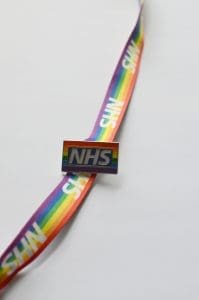 You may have spotted some of our staff wearing NHS rainbow badges and lanyards. This is just one way to show that Gloucestershire Health and Care NHS Foundation Trust (GHC) services are open, non-judgmental and inclusive places for people who identify as LGBTQI+ – all identities, regardless of how people define themselves.
About the initiative
The rainbow badge initiative began at Evelina London Children’s Hospital to send a message of inclusion for people that identified as LGBTQI+. Lesbian, gay, bi and transgender people in the UK can still face significant barriers to accessing healthcare, which can have a direct impact on their physical and mental wellbeing. Research shows that:
- one in five LGBTQI+ people are not ‘out’ to any healthcare professional about their sexual orientation when seeking general medical care
- one in seven have avoided treatment for fear of discrimination
- one in eight have experienced some form of unequal treatment from healthcare staff because they identify as LGBTQI+ (Stonewall, Nov 2018)
- Most NHS Trusts in the UK now provide rainbow badges and lanyards to staff to help reduce these barriers.
At GHC we are fully committed to providing a safe and inclusive environment for all our patients, colleagues and visitors. Simple visible symbols, like the rainbow badges and lanyards, are designed to remind everyone that GHC is a safe space to talk, be open and get support if needed.
Have you spotted someone wearing a rainbow badge?
If you see a member of staff wearing a rainbow badge, ask them about it! It is a reminder that you can be open with all GHC staff about your identity and who you are. They will listen and respond without judgement and do their best to get you support if you need it. If you work for us and would like to know more, visit our staff intranet for more information about our lanyard and badges and how to make a pledge.
Patient and Carer Race Equality Framework (PCREF)
PCREF is an ambitious and transformative programme where partnership working is at its heart. We welcome people’s thoughts and views on how we can improve our services in line with the aims of PCREF. To get involved email pcrefinbox@ghc.nhs.uk.
What is the framework?
The Patient and Carer Race Equality Framework was a key recommendation following the national Mental Health Act Review in 2018. PCREF is NHS England’s accountability framework to tackle and eliminate the unacceptable racial inequalities in access, experience and outcomes faced by Black, Asian, and Multi-Ethnic communities and to significantly improve their trust and confidence in mental health services.
The PCREF is split into three core components:
- Part 1: Leadership and Governance – Meeting Statutory and Legal requirements
- Part 2: National Organisational Competencies
- Part 3: The Patient and Carers Feedback Mechanism
We are able to look at our service data and clearly see which groups have the best and worst access, experience and outcomes (AEO). Our Trust data shows that patients from Black African, Black Caribbean, Black Mixed and Black Other census categories have the worst access, experience and outcomes with us and we are focusing on these groups.
For more information about PCREF and our commitment to it, please contact us.
Trust Statement on Modern Slavery
Modern slavery is the recruitment, movement, harbouring or receiving of children, women or men through the use of force, coercion, abuse of vulnerability, deception or other means for the purpose of exploitation. Individuals may be trafficked into, out of or within the UK, and they may be trafficked for a number of reasons including sexual exploitation, forced labour, domestic servitude and organ harvesting.
The Trust (GHCNHSFT) fully supports the Government’s objectives to eradicate modern slavery and human trafficking and recognises the significant role the NHS has to play. We are strongly committed to ensuring our supply chains and operational activities are free from ethical and labour standards abuses.
Slavery and Human Trafficking Statement for Financial Year 2020/21
During the last financial year, the Trust took, and continues to take, the following steps to ensure that slavery and human trafficking is not taking place:
- We confirm the identities of all new employees and their right to work in the United Kingdom
- All staff are appointed subject to references, health checks, immigration checks and identity checks. This ensures that we can be confident, before staff commence duties, that they have a legal right to work within our Trust
- We have a set of values and behaviours that staff are expected to comply with, and all candidates are expected to demonstrate these attributes as part of the selection process
- By adopting the national pay, terms and conditions of service, we have the assurance that all staff will be treated fairly and will comply with the latest legislation. This includes the assurance that staff received, at least, the national minimum wage from 1 April 2015
- We have various employment policies and procedures in place designed to provide guidance and advice to staff and managers but also to comply with employment legislation
- Our equality and diversity, grievance, respect and dignity at work for staff policies additionally give a platform for our employees to raise concerns about poor working practices
- Our policies and practices promote and support diversity and inclusion both as an employer and service provider; we recognise and acknowledge that diversity and inclusion are key corporate social responsibilities and a Diversity Network for all staff has been in place since our Trust inception in October 2019.
- Our mandatory safeguarding training includes modern slavery as a topic; all clinical staff receive training as part of our Trust bespoke level 2 safeguarding adult e-learning training and also level 3 safeguarding adult training
- Our Trust “Safeguarding Adult at Risk Policy”, and the countywide multi-agency safeguarding policy, to which our Trust is a partner signatory, also includes modern slavery and we have produced communications materials to raise awareness amongst staff and anyone working on or otherwise attending our sites
- Our Freedom to Speak: Raising Concerns (Whistleblowing) Policy gives a platform for employees to raise concerns for further investigation, and our Freedom To Speak Up Guardian and Safeguarding teams actively ensure they are accessible to staff
- The Procurement Team work on the principle of zero tolerance of modern slavery in our supply chain. Our standard terms and conditions require suppliers to comply with relevant legislation and tender evaluations include Social Economic factors. A large proportion of the goods and services procured are sourced through Government supply frameworks and contracts also require suppliers to comply with relevant legislation
- We continue to work with our suppliers directly and via partners, such as NHS Supply Chain, to support initiatives related to modern slavery.
Review of Effectiveness
The Trust will continue to take further steps to identify, assess and monitor potential risk areas in terms of modern slavery and human trafficking, particularly within supply chains. We aim to:
- Raise awareness and support our staff to understand and respond to modern slavery and human trafficking, and the impact that each and every individual working at our Trust can have in keeping present and potential future victims of modern slavery and human trafficking safe
- Ensure that all staff continue to have access to training on modern slavery and human trafficking which will provide the latest information and the skills to deal with it
- Embed Social Value best practice into commercial processes which will achieve improved Social Value awareness and compliance across all our commercial activities
- Impact assess all new or reviewed policies for diversity and inclusion compliance
This statement is made pursuant to section 54(1) of the Modern Slavery Act 2015 and constitutes our slavery and human trafficking statement for the financial year ended 31 March 2021.
Workforce Disability and Race Equality Standards
We are pleased to publish the 2025/26 Workforce Disability Equality Standard (WDES) and Workforce Race Equality Standard (WRES) data Report and Action Plans.
These are live plans and have been pulled together in collaboration with the Trust’s Networks and the action plan leads, with much of the work already underway.
If you have any questions about the plans, or you would like to find out more, please contact our Organisational Development and Inclusion team; EqualityDiversityInclusion@ghc.nhs.uk
Our previous Workforce Disability Equality Standard and Workforce Race Equality Standard Action Plans
- WDES and WRES 2024-25 Action Plan
- WDES and WRES 2023-24 Action Plan
- WDES and WRES 2022-23 Action Plan
- WDES and WRES 2022 Summary Data and Action Plan – Reviewed Oct 2022
- A Model Employer – Increasing black, Asian and minority ethnic representation at senior levels
Click here for further information about WRES and for more information on WDES.